
Did you know that the recent World Championships was still only the second-fastest during the period 1993–2026 (Fig. 1a). Analysis of 11 consistent boat classes reveals that it was 0.16% slower than the fastest Worlds, held in 2014 on the same Bosbaan rowing course in Amsterdam
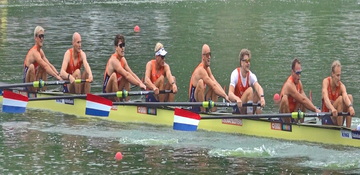
Three world records were set during this regatta: W4− USA clocked 6:09.87 (4.49 s faster than the previous record set in 2014); M8+ NED recorded 5:17.75 (0.93 s faster than WBT set in 2017); and W8+ ROU finished in 5:51.88 (1.11 s faster than WBT set in 2021).
The linear trend over this period shows an average increase in speed of 0.049% per year, with substantial differences between boat types. Similar to our previous findings, the fastest growth was observed in both eights: 0.144% in W8+ and 0.111% in M8+. All three men’s sculling boats followed the eights, but with more than twofold lower growth rates, ranging from 0.046% in M2x to 0.052% in M1x. W2− was close to the male scullers, with a growth rate of 0.042%, followed by W2x, W1x and M4−, all with similar growth rates of about 0.033%. At the bottom of the ranking, as before, was W4x, with a growth rate of only 0.007%, while M2− was the only boat class with a negative trend, at −0.030% per year.
More sophisticated analysis of speed growth, using a 10-year sliding average, reveals a clearly positive general trend over the last three decades. The average growth became positive in the decade ending in 2023 and has continued to increase. This may be related to favourable weather conditions at several recent major regattas, including the 2021 and 2024 Olympic Games in Tokyo and Paris, as well as this year’s World Championships.
The stroke rate continues to increase and has now reached its highest-ever level, with an average value of 40.71 spm among the winners in the 11 consistent boat classes. The previous highest stroke rate, 40.36 spm, was recorded at the Paris 2024 Olympics.
It is interesting that the average stroke rate among the different rower categories has now become very similar. Its average value among the winners of the three men’s sculling boats was the highest, at 41.0 spm, while in the other three categories the winners showed very similar average stroke rates of 40.4–40.5 spm. Contrary to our previous findings, the winners raced at an average stroke rate 1.0 spm higher than the silver medallists and the average value for all A-finalists.
Among the major rowing nations, Romanian crews (6 boats in A-finals) raced at the highest stroke rate, 41.1 spm, followed by Italian (5) and Dutch (9) rowers at 40.9 spm. German crews (6) raced at 40.5 spm, while American (8) and British (8) crews both averaged 39.8 spm. Australian (4) and New Zealand (3) rowers had the lowest stroke rate in this group, at 39.2 spm.
An analysis of race strategy revealed that the winners had the most even speed distribution among the finalists. This differs from our previous publication (RBN 2024/07), but is consistent with our earlier studies. The Paris 2024 regatta was, probably, an exception to the general pattern.
The averaged distribution of stroke rate over the 250 m sections clearly shows that the winners had a significantly higher stroke rate throughout the race, but did not have the highest Effective Work per Stroke, EWpS. Again, this finding is opposite to what was observed previously: this year, the silver-medallist crews produced significantly higher EWpS throughout the race.
What can be learned from all this information? It is quite clear that a high Effective Work per Stroke was a prerequisite for reaching the podium at this regatta: all three medallists had distinctly higher EWpS than the other finalists. However, among the medallists, crews with the highest stroke rates managed to overtake the others and win the gold medals.
How far will top rowers be able to increase their stroke rate? Inertial efficiency decreases exponentially at higher stroke rates (RBN 2021/03): from 40 to 44 spm, it decreases by 2.3% (approximately 8 W of power loss), while from 44 to 48 spm it decreases by a further 2.9% (10 W less). These losses are associated only with the movement of the rower-boat masses, while the rower must also expend additional energy on changes in body configuration, oar movement, and other processes. Therefore, the actual losses could be even greater. Thus, at present, 42–44 spm could be considered a natural upper limit for stroke rate.
This is a short version of the Newsletter. To access the full text, please subscribe to BioRow membership here: https://biorow.com/membership/
©2026 Dr. Valery Kleshnev
Welcome Back 👋
Sign in to access your account and continue where you left off.
Welcome aboard 🚀
Create your account to access everything you need.