
Did you know that… each kg of added boat mass reduces rowing speed by 0.15%? This is about 2.5 times greater than predicted by the previous theoretical model. The real increase of hydrodynamic drag could be higher, but it was partially balanced by improved boat velocity efficiency.
The effect of boat mass on rowing biomechanics, speed, and efficiency is an important question within the rowing community; however, experimental evidence is still lacking. A previous theoretical analysis (RBN 2009/02) identified three mechanisms by which additional boat mass may influence rowing speed, each acting in a different direction:
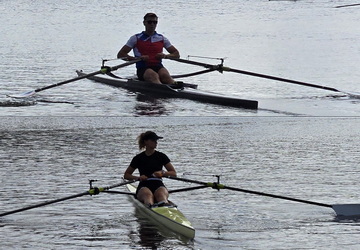
In our recent experiment, additional masses of 2.5, 5.0, and 10.0 kg were added to a single sculling boat. Two scullers (M1x male: 1.96 m, 92 kg; W1x female: 1.77 m, 70 kg) each completed six 1000 m trials with progressively increasing stroke rates (target: 20, 25, 30, 35, and 40 spm) using their own boats (WinTech and Filippi). The original boat mass, including oars and the BioRow measurement system, was 18.5 kg, giving a maximum total boat mass of 28.5 kg.
Each trial was performed with the two scullers rowing simultaneously, with one boat carrying the additional weight and the other serving as the control. In the subsequent trial, the additional weight was transferred to the other boat so that comparisons between paired trials minimized the influence of changing weather conditions. The same procedure was repeated for each added mass.
The effects of additional mass were most pronounced around the catch. Increasing boat mass reduced the magnitude of the negative acceleration peak at the catch and lowered the first positive acceleration peak, particularly at the higher stroke rate. This flatter boat acceleration after catch may reduce the “trampoline effect” and make the drive heavier and less dynamic.
The velocity of the heavier boat was higher immediately after the catch, but lower during the finish phase, although the latter effect was evident only at the lower stroke rate. Consequently, velocity fluctuations decreased, which should improve rowing efficiency, corresponding to predicted speed gains of 0.59% at 20 spm and 0.32% at 35 spm with 10 kg of added mass. Thus, the beneficial effect of reduced boat velocity fluctuations was about 0.04% per kg of added mass, almost three times smaller than predicted.
The second mechanism, increased hydrodynamic drag, was evaluated by comparing differences in Gross Drag Factor DFg between the two scullers in each paired trial. On average, an additional 10 kg increased DFg by 4.2%. As DFg was defined as the ratio of rowing power to average speed (DFg = P / v3), it incorporates the effect of reduced boat velocity fluctuations (point 1 above).
The third proposed mechanism, increased inertial energy loss, was expected to reduce rowing power. However, no significant relationship was observed between rowing power and boat mass. Likewise, no significant correlation of boat mass with rowing speed was detected. Other biomechanical variables (force curve, velocities of the handle and seat) were also not affected.
The rowers reported that increases in boat mass of up to 5 kg were barely noticeable. Both stated that with an additional 10 kg, the boat “felt heavier at the catch” consistent with the biomechanical observations described above.
Not all inertial energy expenditure is irreversibly lost. With a dynamic “bouncing” “catch through the stretcher” technique, part of the internal kinetic energy may be converted into propulsive work during the drive. Likewise, with “finish through the handle”, a portion of the kinetic energy may be transferred to propulsion.
Overall, the findings suggest that the additional inertial losses associated with a heavier boat may primarily reduce the rower’s internal mechanical efficiency, increasing metabolic energy expenditure and stretcher loading without affecting handle power.
This is a short version of the Newsletter. To access the full text, please subscribe to BioRow membership here: https://biorow.com/membership/
©2026 Dr. Valery Kleshnev
Welcome Back 👋
Sign in to access your account and continue where you left off.
Welcome aboard 🚀
Create your account to access everything you need.