
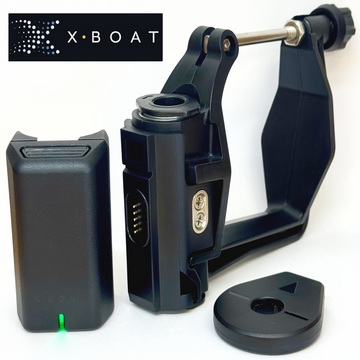
Did you know that… a new XBoat measurement system (https://xboat.com ) appeared on the rowing market, and was tested and evaluated recently? At first glance, the system looks well designed and compact: it is fully wireless, with oarlock-based force and angle measurements, a rechargeable battery, real-time feedback on a 6.5-inch glare-resistant display, and a web-based application for data analysis. To address coaches’ concerns, the XBoat system was evaluated by comparing its metrics with traditional data obtained with BioRow system.
The experiment was conducted in a JM8+ boat instrumented with both XBoat and BioRow systems. The crew performed the standard BioRow 2000 m step-rate test, and data were acquired simultaneously with both systems. BioRow data was processed using our standard methods. XBoat data were uploaded to the company’s web server and processed there. The main rowing sections were identified automatically, and it was possible to select samples manually with greater precision to match BioRow samples. Seven samples at stroke rates ranging from 20 to 38 spm were compared. The XBoat software produces averaged data patterns for each sample interval, which is a significant improvement over the Peach system, although the averaging method was not explained.
Unfortunately, information about XBoat data collection and analysis was very limited. It is unclear how force is measured at the oarlock: whether it is measured in a fixed direction relative to the boat (pin force, as in the Peach system), or whether the force direction is referenced to the rotating oar/swivel (gate force, as in the NK EmPower oarlock)? In addition, no numerical data output was available; only on-screen information and PDF printouts.
The XBoat force-time chart shows that the stroke cycle is triggered at the finish of the drive. Comparison with the BioRow force curves revealed significant discrepancies: most XBoat curves exhibited a later peak force, which was also reflected in the crew-averaged curve. In the worst case, on the stroke seat, the force curve was almost completely reversed.
Boat acceleration curves were similar in both systems; however, the XBoat curve was more heavily smoothed and scaled differently: its minimum peak was approximately −5 m·s-2, compared with −7.7 m·s-2 in the BioRow system.
The angular velocity profiles were quite similar during the middle of the drive and recovery phases, but differed substantially at the catch and finish. This discrepancy was a consequence of oar backlash within the oarlock, as for all gate-based sensors.
A comparison of average XBoat metrics for each rower and sample (n = 56) with the corresponding BioRow values revealed a surprisingly high correlation for rowing power (r = 0.94). The slope of the regression line indicates that, on average, rowing power measured by the XBoat system was 3.6% lower than that measured by BioRow. However, this difference varied substantially between seats, ranging from −11% to +10%. This variation was probably related to inaccurate calibration of the XBoat sensors.
Other metrics showed considerably lower correlations: r = 0.70 for both Work per Stroke and Maximal Force, r = 0.88 for Catch Angle, r = 0.57 for Stroke Length, and the lowest correlation, r = 0.27, for Finish Angle. The regression slopes and averaged values indicate that, on average, the XBoat system reports a 5.7% greater Stroke Length, but a 3.2% lower Maximal Force than the BioRow system. Again, substantial variations were found in these differences between seats: Stroke Length differed from +1.5% to +9.6%, while Maximal Force ranged from −11.2% to +11.1%. The important metric Average Force over the drive was not available in the XBoat data output.
In conclusion, the XBoat system represents a step forward in rowing biomechanics technology, offering user-friendly hardware and advanced web-based software. It provides basic biomechanical measurements of oar angles, forces, and rowing power; however, its accuracy raises serious concerns. With its real-time feedback capabilities, the system could be useful for functional and technical training, but it appears unsuitable for crew selection, where accurate and consistent measurements between rowers are essential.
This is a short version of the Newsletter. To access the full text, please subscribe to BioRow membership here: https://biorow.com/membership/
©2026 Dr. Valery Kleshnev
Welcome Back 👋
Sign in to access your account and continue where you left off.
Welcome aboard 🚀
Create your account to access everything you need.