
Did you know that… telemetry results should be used primarily for improving rowing technique and applied very cautiously in rower selection?
Here we address common questions from coaches, such as: “Why do some rowers show high wattage with the Peach system but are not successful in small boats or seat racing?” and “How can telemetry be used for rower selection?”
First, the ratio of Peach wattage to rowing power measured with the BioRow system was calculated, which ranged from 97.4% to 116.7%. Higher values indicate higher Peach wattage at lower rowing power measured with the BioRow system, and vice versa. The ratio was then correlated with the main biomechanical indicators measured in a JW8+. The four highest positive correlations were related to timing: Peach wattage was relatively higher when the blade entry and exit were later and catch angle was shorter. On the negative side, all significant correlations showed that higher average force, work per stroke (WpS), rowing power, longer stroke length, and faster handle velocity were associated with a lower ratio of Peach wattage to BioRow power. This suggests that the Peach system smoothes out differences in power production between rowers compared with BioRow measurements.
To illustrate these findings, a case study was conducted comparing two rowers: Rower 1 (1.86 m, 68 kg), who had the highest Peach/BioRow power ratio (116.7%), and Rower 2 (1.82 m, 64 kg) with the lowest value in this crew (97.4%). Their data allow the conclusions; where Rower 2 differs in the following specifics:
Rower 2 changed direction at the seat earlier, resulting in a catch factor of -29 ms, whereas Rower 1 had a value of +3 ms.
The most important differences were found in force and power production:
Such ambiguous results raise serious doubts about the validity of using power meters for rower selection. The insight from the coach was the following: “Rower 1 is taller, heavier and stronger on the erg, while Rower 2 is faster in the single scull and in the pair (depending on the partner)”.
The reasons for these phenomena can be found in the specifics of force and power measurements in the two systems.
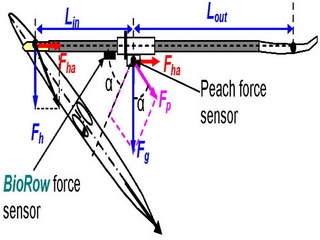
The BioRow force sensor is attached to the oar shaft; therefore, it effectively measures oar bend, which is directly proportional to the torque, equal to the product of handle force and the length of its lever relative to the pin. Each oar is calibrated by applying a dynamic force at a defined point at the center of the handle, when the lever length is known and the stiffness factor is determined.
During rowing, the actual lever length is uncertain, because a rower may vary the point of force application, but does not affect the calculation of rowing power in BioRow system. Moreover, rowers typically apply force not exactly perpendicular to the oar axis, creating an axial force component along the shaft. This axial handle force does not produce mechanical power because there is no movement in this direction. The axial force does not affect oar bend and therefore – the measured torque or power in BioRow system.
The mechanics are very different in gate-based systems, especially when the sensor is fixed on the pin, as in the Peach system. In this case, torque and rowing power must be derived from the measured pin force using uncertain inboard lever and the actual outboard lever, which is also uncertain and may vary during the drive. In addition, the axial force Fha affects the measured pin force at non-perpendicular oar angles, further reducing the accuracy of rowing power measurements and allowing potential “cheating” in rower selection.
BioRow and other oar-based systems provide the most accurate rowing power measurements, with an estimated error of less than 1%. However, many other factors influence power data, such as synchronisation in a crew and power transfer through the stretcher and boat.
This is a short version of the Newsletter. To access the full text, please subscribe to BioRow membership here: https://biorow.com/membership/
©2025 Dr. Valery Kleshnev