
Did you know that… “What drag factor (DF) should be set on an ergometer to correspond to rowing in a certain boat type? This is an important issue because a specific DF is used for rower testing and selection (usually 130-140).
To answer this question, the Handle Drag Factor (HDF), a “burden factor,” was used to compare biomechanical conditions on water and on the Concept2 RowErg – the most popular rowing machine. HDF was developed in 2011 and analyzed in 2020 for on-water rowing using the BioRow database.
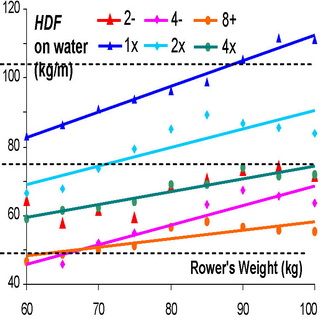
It was found that HDF on water significantly depends on the rower’s weight, which is expected: boats with heavier rowers have greater water displacement and a higher drag factor, making rowing more demanding. Correlations were very high, ranging from r = 0.83 in pairs to r = 0.99 in singles. Larger and faster boats have lower HDF, while smaller and slower boats have higher HDF. This is also expected, as higher boat speed allows greater handle velocity and lower HDF. Sculling boats have higher HDF than sweep boats due to longer oar angles (heavier dynamic gearing) and a larger total blade area (resulting in less slippage in the water). Notably, HDF trends in pairs and quads were nearly identical.
The slopes of the HDF trends indicate the increase in HDF per additional kilogram of rower weight. It was found that rower weight has a greater effect on HDF in smaller boats: in singles, one extra kilogram increases HDF by 0.75 kg/m, whereas in eights, the effect is three times smaller, at only 0.25 kg/m. This may explain why larger and heavier rowers tend to prefer bigger and faster boats.
In contrast to on-water rowing, HDF on ergometers does not depend on rower weight and power, which was expected and confirmed by nearly zero correlations in the latest analysis. HDF was found to have an almost perfectly linear correlation with damper and DF settings on the Concept2 RowErg (r = 0.999), confirming the validity of the HDF indicator. This also allows direct comparison between damper and DF settings and HDF, and subsequently with on-water rowing:
Therefore, DF settings on an ergometer do not have a one-to-one correspondence with on-water rowing in a specific boat type. Rower weight must also be taken into account. BioRow members can use our new online calculator for more detailed analysis.
HDF on water is the more variable indicator. It is influenced by weather conditions (higher in headwinds, lower in tailwinds), power imbalance within a crew (higher for stronger rowers, lower for weaker ones), and oar angles (longer angles increase HDF). Therefore, the derived values are valid only for a typical crew rowing in neutral weather conditions with average oar angles.
On the Concept2 RowErg, HDF is more consistent than on water. It shows no correlation with stroke length, force magnitude, or power output. The strongest correlation was found with Catch Factor (r = 0.534), indicating that a more negative Catch Factor makes rowing on the Concept2 RowErg feel lighter, while a positive Catch Factor makes it heavier. A possible explanation is that an earlier reversal of seat movement before the catch allows earlier acceleration of the rower’s mass. As a result, at the catch, the rower’s mass is already moving, allowing more energy to be directed toward rapid force development, which was supported by positive correlations of ΔHDF with catch force gradient (r = 0.34) and peak force position (r = 0.31), as well as a negative correlation with the ratio of average to maximal force (r = -0.41), indicating that a more rectangular force curve reduces HDF.
Does this lighter sensation indicate greater efficiency or better performance? This cannot be confirmed with the available data. More in-depth experimental studies, including measurements of energy expenditure (VO₂, lactate), are required to determine this.
This is a short version of the Newsletter. To access the full text, please subscribe to BioRow membership here: https://biorow.com/membership/
©2026 Dr. Valery Kleshnev
Welcome Back 👋
Sign in to access your account and continue where you left off.
Welcome aboard 🚀
Create your account to access everything you need.